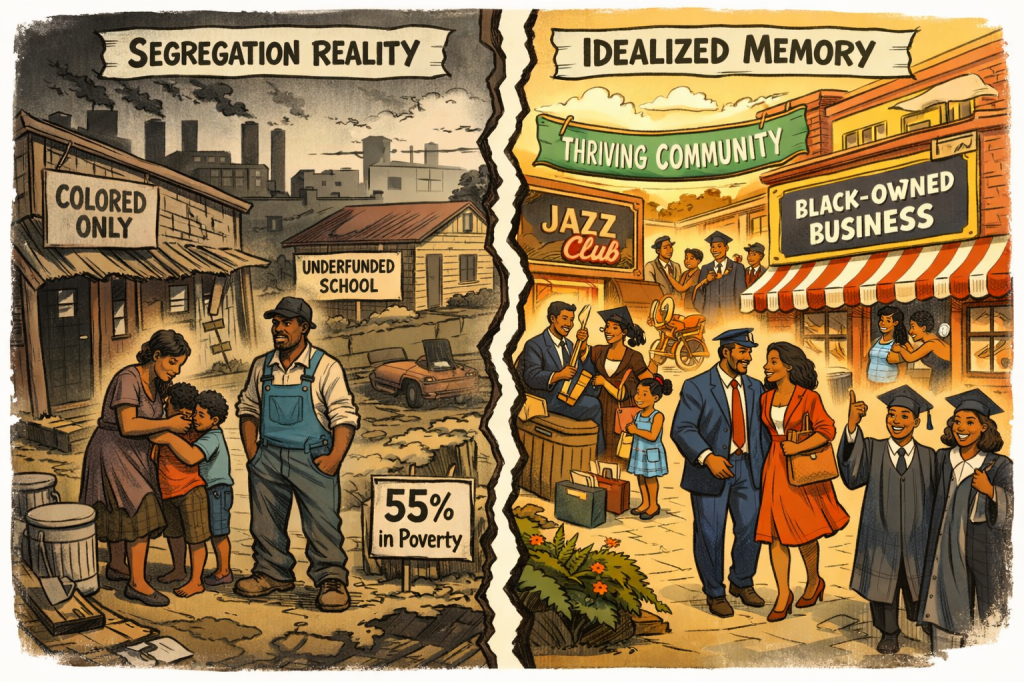
When I see Black people online talking about how segregation was somehow better for us as a people, I feel something rise up in me that I can’t ignore. Not just frustration—something deeper. A kind of ancestral irritation. Because what are we really saying when we romanticize a time built on restriction, humiliation, and enforced limitation?
Yes, we built strong communities. Yes, we created beauty, businesses, culture, and excellence in spite of being shut out. We made do because we had to. There is nothing noble about being locked out and calling it a blessing.
Segregation didn’t empower us—it constrained us. It dictated where we could live, learn, work, eat, and dream. It wasn’t some golden era of unity; it was survival under pressure. And survival can produce brilliance, but that doesn’t mean the conditions were good.
Let’s talk numbers, since nostalgia tends to get real quiet around data. In 1959—the first year the U.S. government officially measured poverty rates—about 55% of Black Americans were living below the poverty line. More than half. By comparison, about 18% of white Americans were in poverty that same year. That wasn’t an accident. That was policy. That was redlining, job exclusion, underfunded schools, land theft, and wage suppression stacked on top of each other like bricks in a wall we were never meant to climb.
So when people say segregation was “better,” I have to ask: better for who? Better how? Better according to what measurable standard?
What people are really mourning, I think, is the loss of tightly knit community, economic circulation within Black neighborhoods, and a sense of collective identity. And that’s real. That mattered. That still matters. But those things weren’t gifts of segregation—they were our response to it.
You don’t have to resurrect oppression to rebuild community. You don’t have to go backwards to reclaim connection.
Sometimes I want to scream because it feels like we’re forgetting the difference between what we created… and what we endured. And those are not the same thing. Not even close.
 The Potty Mouth Granny
Leave a comment