
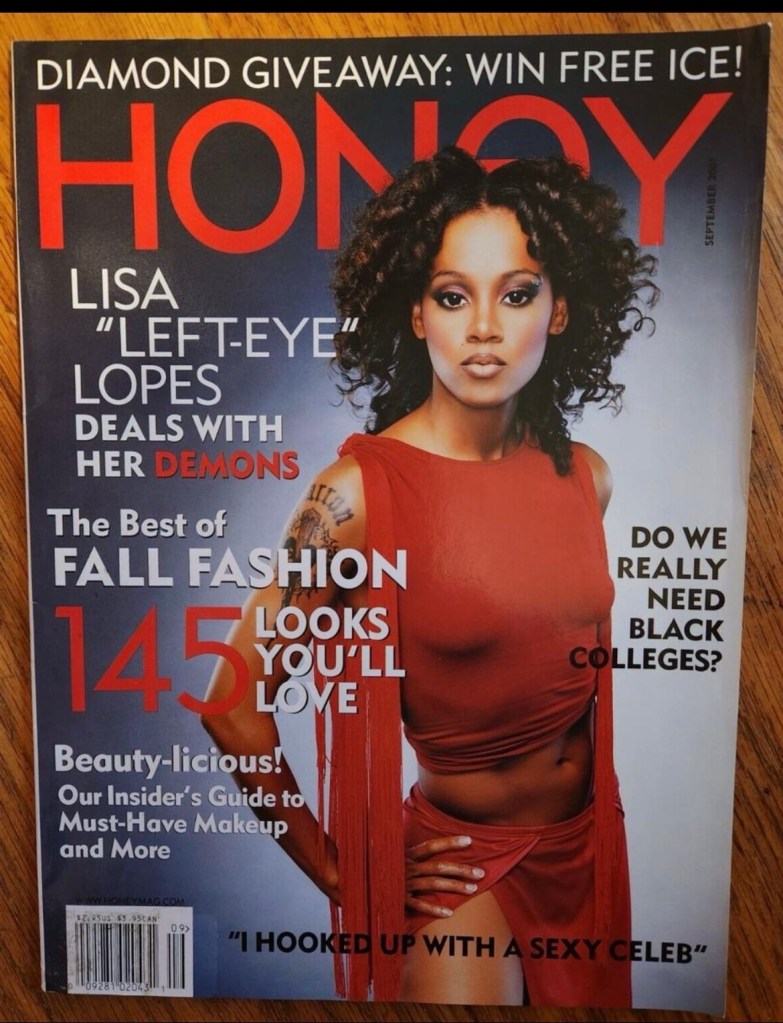
There are magazines you read, and then there are magazines that become part of who you are.
For me, Honey was the latter.
Founded by Kierna Mayo and Joicelyn Dingle, Honey debuted with a preview issue in 1999 featuring Lauryn Hill. It blended fashion, beauty, music, politics, relationships, and culture through a distinctly Black feminist lens and it was simply fucking fabulous.
Honey gave young Black women exactly what we had been craving: a publication that saw us as whole human beings. We weren’t just consumers. We weren’t just girlfriends. We weren’t just mothers or daughters. We were thinkers, creators, artists, professionals, students, activists, dreamers, and women still figuring ourselves out.
Inside its pages, the writing was just as compelling as the photography.
One article might discuss hip-hop’s influence on politics. Another explored beauty standards. Another tackled relationships without talking down to its readers. Then there were fashion spreads that felt attainable instead of aspirational, celebrating Black style without making it a costume for someone else’s entertainment.
Honey assumed Black women were intelligent.
That may not sound radical today, but it certainly was.
For decades, mainstream women’s magazines largely ignored Black women unless they wanted to tokenize us. When we did appear, it was often through someone else’s lens.
Honey changed the camera angle.
It wasn’t asking permission to exist. It simply did.
The magazine captured an era when Black women were redefining ourselves on our own terms. We were entering boardrooms, graduate schools, entrepreneurship, and creative industries while embracing natural hair, spoken word, hip-hop, neo-soul, and independent thought.
It understood that a woman could quote Toni Morrison, wear bamboo earrings, argue politics, listen to Mos Def, and still care about finding the perfect lip gloss.
There was never a contradiction.
That was simply Black womanhood.
Sadly, like too many Black-owned or Black-centered media outlets, Honey struggled to survive in an industry that often failed to invest in publications serving Black audiences. Corporate ownership changed. Advertising dollars became scarce. Eventually, the magazine quietly disappeared.
But its influence never did.
You can still see Honey’s fingerprints everywhere.
Today’s Black women writers, podcasters, YouTubers, and independent creators continue the work Honey started decades ago. The conversations have expanded, and the platforms have changed, but the mission remains remarkably similar: tell our own stories in our own voices.
Perhaps that’s why so many of us still smile when someone mentions Honey.
It reminds us of a time before algorithms decided what deserved attention.
Before every opinion became content.
Before authenticity became branding.
Back then, opening Honey felt like sitting in a room full of brilliant Black women exchanging ideas, laughter, frustration, ambition, and hope.
It reminded us that our experiences weren’t niche.
They were worthy of glossy pages.
As a writer today, I often think about publications like Honey. They proved there has always been an audience for thoughtful, nuanced writing by and about Black women. We never lacked readers. We simply lacked people willing to invest in telling our stories.
Fortunately, we no longer have to wait for permission.
We have websites.
We have newsletters.
We have podcasts.
We have self-publishing.
We have social media.
Most importantly, we have our own voices.
Maybe Honey disappeared from newsstands.
But the women it inspired never stopped writing.
And perhaps that’s its greatest legacy of all.


Leave a Reply