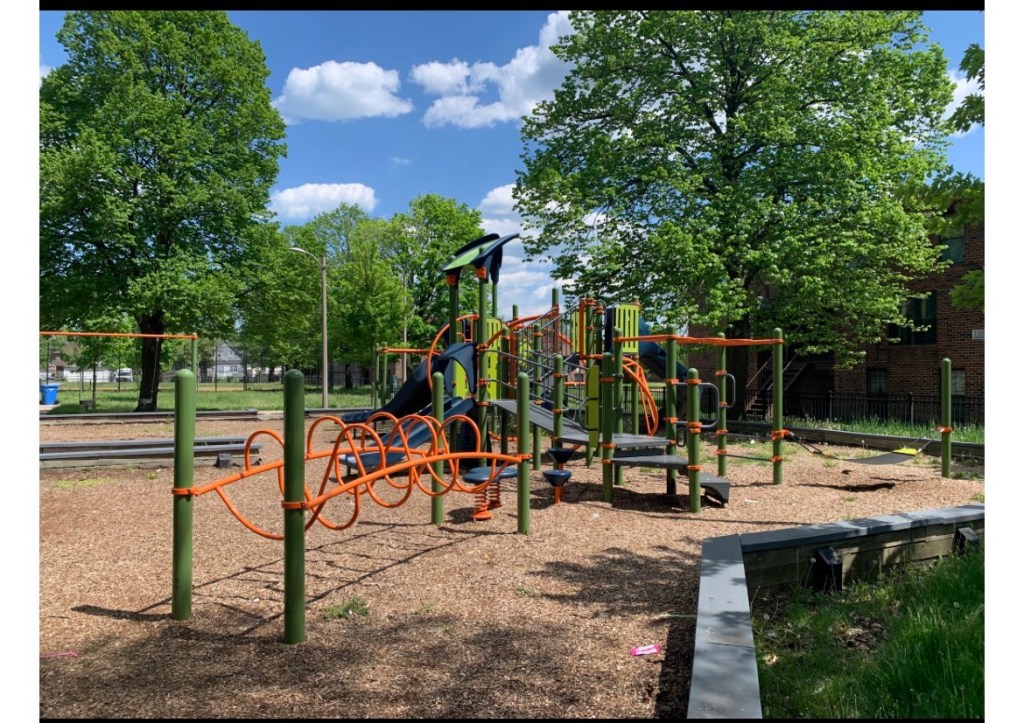
Tourists will never find Hoard Park in a guidebook. It doesn’t have Buckingham Fountain or the grandeur of Jackson Park. It’s just a small neighborhood park tucked away on 72nd and Dobson.
But for me and my childhood friends, it was our treehouse.
Long before I knew anything about urban renewal or city planning, I knew the sound of children laughing across its playground, the squeak of sneakers on the basketball court, and the feeling that the world stretched only as far as the neighborhood streets surrounding it.
Years later, I learned that Hoard Park was created in 1972 as part of an urban renewal project and named after Edison L. Hoard, a man dedicated to serving his community. As a child, none of that mattered to me. It was simply da park.
Looking back now, I realize neighborhoods don’t just shape cities—they shape people. Before I became a writer, before sociology classes and genealogy research and books about history, I was just a little Black girl playing in a small South Side park, collecting memories I didn’t yet know would become stories.
When I think of Hoard Park, I don’t think about urban renewal or city planning. I think about summer nights. We would gather there with our boom boxes, stringing extension cords together so the music could play until late into the night. The park became our dance floor, our meeting place, our therapy session, and our escape. We laughed, argued, flirted, and dreamed under the Chicago sky. Long before social media connected people, parks like Hoard connected us. Those nights weren’t just about the music. They were about belonging.


Leave a Reply