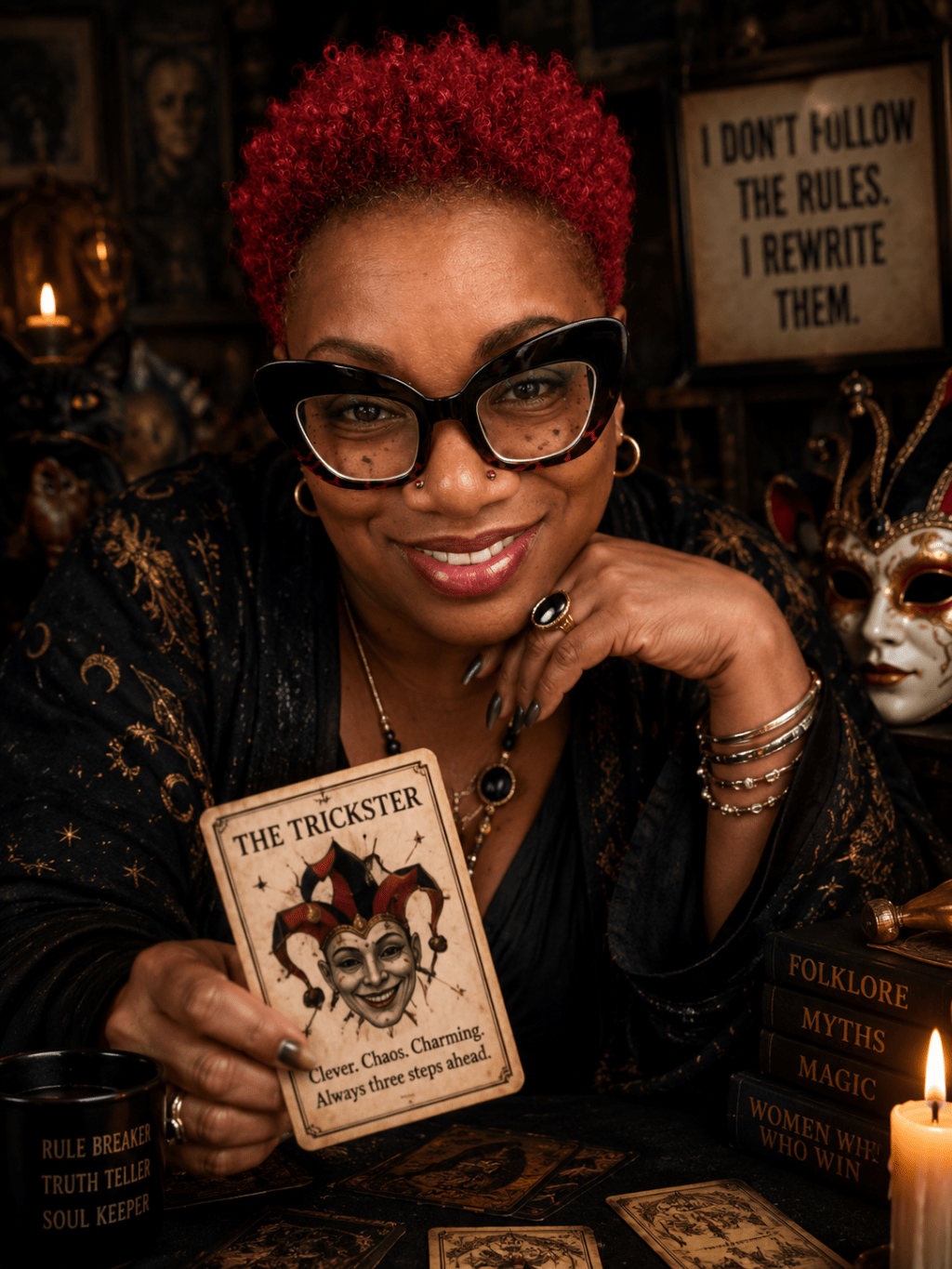
History remembers kings, conquerors, and warriors.
But tucked into the margins of myth, folklore, and history is another figure who refused to play by the rules—the female trickster.
She rarely possesses armies.
She seldom inherits kingdoms.
She isn’t usually the strongest person in the room.
So she becomes the smartest.
The female trickster understands a simple truth:
When the world denies you power, you learn how to bend power instead.
Unlike her male counterpart, who often delights in chaos for its own sake, the female trickster is frequently driven by survival. She lives in societies where speaking too loudly can get her punished, where ambition is considered unattractive, and where obedience is expected.
So she smiles.
She watches.
She waits.
And when everyone underestimates her…
She wins.
Think of the fox spirits of East Asian folklore, whose beauty and wit allow them to deceive those blinded by greed or arrogance. Consider Anansi’s female counterparts in African storytelling, whose cleverness often rescues families from impossible situations. Even in European fairy tales, the old woman in the forest—the one dismissed as a harmless crone—is often the only person who truly understands what’s happening.
The female trickster also appears throughout history.
Women who disguised themselves as men to fight in wars.
Queens who manipulated rival kingdoms through diplomacy instead of battle.
Spies who gathered secrets because powerful men assumed women weren’t paying attention.
Con artists who exploited society’s own stereotypes against it.
People often confuse the female trickster with the femme fatale.
They aren’t the same.
The femme fatale is typically defined by her sexuality.
The female trickster is defined by her mind.
She may use charm.
She may use humor.
She may even play the fool.
But those are tools—not her identity.
Her real weapon is perception.
She notices what everyone else overlooks.
Carl Jung believed every archetype lives inside us, and the female trickster reminds us that intelligence is often disguised. She exposes hypocrisy not by shouting, but by allowing people to reveal themselves.
There’s an old saying:
“Never interrupt your enemy when he’s making a mistake.”
The female trickster perfected that philosophy centuries ago.
Perhaps that’s why older women so often become tricksters in folklore.
Once they stop worrying about being agreeable, they become wonderfully dangerous.
The old crone who knows every herb in the forest.
The grandmother who sees through everyone’s nonsense.
The widow everyone dismisses until she quietly outmaneuvers the entire town.
Age frees her.
Experience sharpens her.
She no longer needs permission to speak uncomfortable truths.
Maybe that’s why society has always been a little afraid of older women.
They’ve seen too much.
Lost too much.
Learned too much.
They’re harder to manipulate because they’ve already met every variety of fool.
The female trickster reminds us that power isn’t always loud.
Sometimes it’s a raised eyebrow.
Sometimes it’s a perfectly timed question.
Sometimes it’s saying nothing at all while everyone else tells on themselves.
And sometimes…
The most dangerous woman in the room is the one everyone assumed wasn’t paying attention.
That’s the trick.
She always was.


Leave a Reply