Every now and then I fall down one of my historical rabbit holes and come across a woman—real, legendary, mythical, whatever—who makes me stop and say, now who the hell is this?
Today that woman is Mélusine.
And baby, Mélusine has a story.
She has been called the Devil’s daughter, a fairy, a water spirit, a serpent woman, a dragon woman, a demon, a mother, a wife, a builder of castles and even the legendary ancestor of European nobility.
Basically, they threw everything but the kitchen sink at this woman.
The best-known version of her story comes from medieval France, particularly Jean d’Arras’s Roman de Mélusine, written in the late 1300s.
Despite the juicy nickname “the Devil’s daughter,” Mélusine wasn’t originally Satan’s little girl.
Her mother, Pressine, was a fairy.
Her father was a mortal king.
Already we have problems because anytime a beautiful supernatural woman hooks up with a mortal man in medieval folklore, somebody is eventually going to violate a boundary.
And sure enough, that is exactly what happened.
Mélusine eventually meets a nobleman named Raymondin and agrees to marry him.
But she has one condition.
Leave me the hell alone on Saturdays.
Okay, she probably didn’t say it exactly like that.
But that was the arrangement.
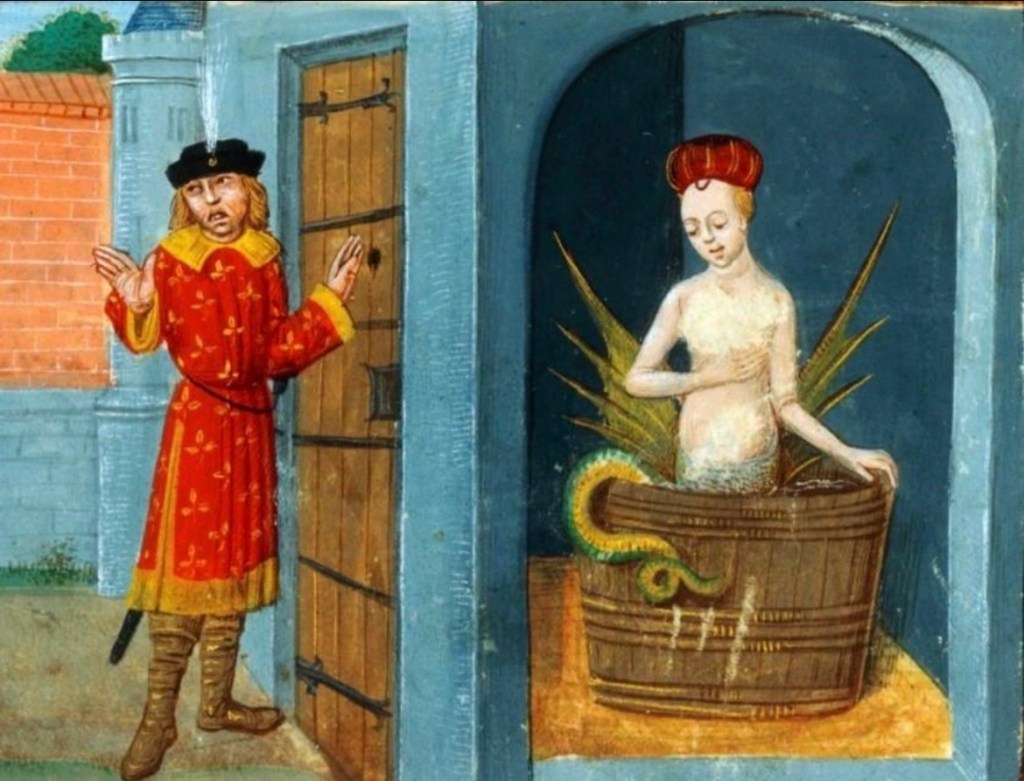
Every Saturday, Mélusine withdrew into privacy because she was under a curse that caused the lower half of her body to transform into the body of a serpent.
All Raymondin had to do was mind his business.
That’s it.
He had a beautiful wife. She helped make him wealthy. She built castles. She established communities. She gave him children. The woman was apparently out here doing medieval economic development.
And his sole assignment was:
Don’t come looking for me on Saturday.
Guess what that fool did?
Went looking for her on Saturday.
Because apparently male curiosity has been fucking up perfectly good relationships since the Middle Ages.
Raymondin spies on Mélusine while she is bathing and discovers that his beautiful wife is half woman and half enormous serpent.
Now, personally, if my wife had built me castles, produced heirs, increased my wealth and asked for ONE DAY A WEEK to herself, I would suddenly become the least curious person in Europe.
Saturday?
Never heard of it.
See you Sunday, baby.
But Raymondin couldn’t leave well enough alone.
Eventually her secret became public, the trust between them was shattered, and Mélusine left—sometimes described as transforming into a dragon and flying away.
But what fascinates me isn’t the snake.
It’s what people did with the snake.
Because Mélusine wasn’t originally just some evil creature creeping around waiting to destroy men.
She was a builder.
A mother.
A wife.
A protector.
A source of wealth and prosperity.
Medieval noble families, most famously the House of Lusignan, were even associated with stories claiming descent from her.
Think about that.
People could brag that their powerful aristocratic family descended from a magical serpent woman while simultaneously living in a culture increasingly suspicious of powerful supernatural women.
That’s human beings for you.
We are nothing if not contradictory.
And over time, particularly through Christian interpretation, the serpent imagery became increasingly sinister.
Because of course it did.
Woman.
Beautiful.
Powerful.
Secretive.
Independent.
Associated with water and magic.
Turns into a serpent.
Medieval Christianity looked at all that and basically said:
SATAN!
And this is one of the things I find endlessly fascinating about mythology.
When you start looking closely at old stories, women who possess unusual power have an amazing tendency to become monsters.
Women who know too much become witches.
Women who seduce become demons.
Women who live outside male control become dangerous.
Women connected to nature become pagan temptresses.
And apparently women who ask their husbands for one damn day of privacy grow snake tails.
Mélusine reminds me of something else too.
There are countless old legends built around the idea that a supernatural woman will love a mortal man as long as he respects one boundary.
Don’t open this door.
Don’t look inside this room.
Don’t ask this question.
Don’t follow me.
Don’t look at me on Saturday.
And inevitably…
That motherfucker opens the door.
Then everybody acts shocked when the magical woman disappears.
Sir.
You had ONE JOB.
Maybe that is why I enjoy these stories so much.
Underneath the dragons and fairies and curses, they’re still stories about human beings.
Curiosity.
Trust.
Marriage.
Power.
Betrayal.
Fear.
And the eternal inability of some people to mind their own damn business.
So was Mélusine really the Devil’s daughter?
Not originally.
But I can certainly see how she eventually earned the reputation.
A beautiful, powerful woman who builds kingdoms, produces heirs, possesses supernatural power and refuses to explain everything she does?
Hell.
Patriarchy has called women devils for much less.


Leave a comment