The Beauty of Full-Figured Women Through the Eyes of Peter Paul Rubens
By The Potty Mouth Granny
Somewhere along the way, society decided that women were supposed to be thin to be considered beautiful. Flat stomachs, slender thighs, narrow waists, and bodies that seemingly defy gravity became the standard.
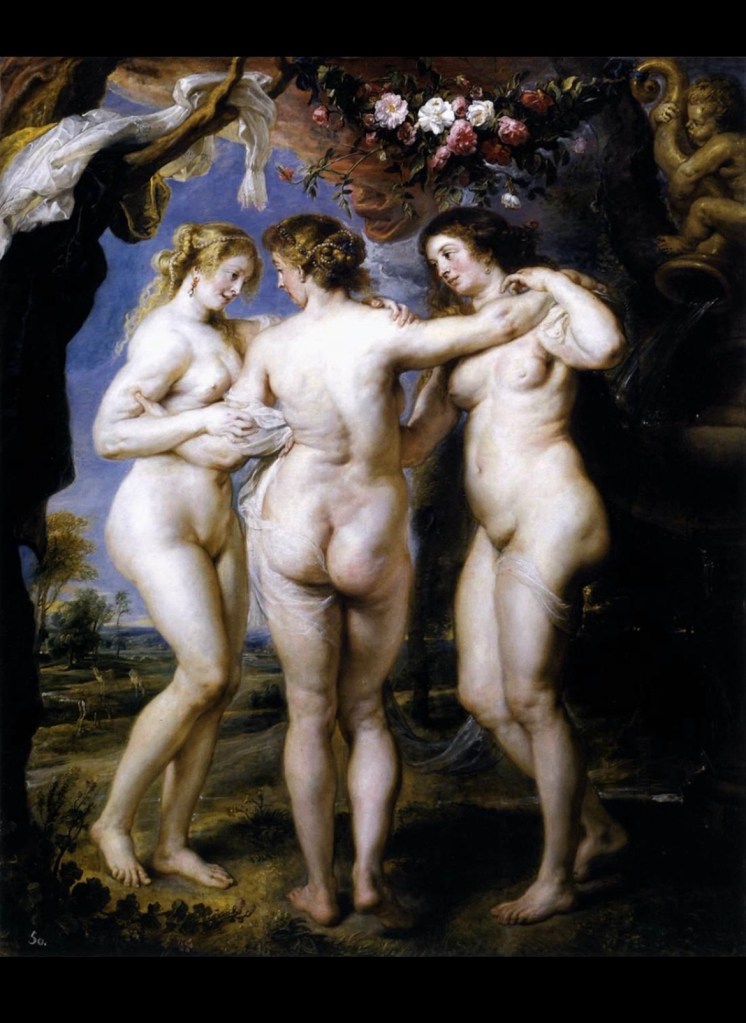
The Three Graces (c. 1630–1635)
Women have spent decades starving themselves, squeezing into shapewear, undergoing cosmetic procedures, and torturing their bodies to achieve an ideal that seems to change every twenty damn minutes.
But there was a time when a woman with a generous belly, thick thighs, ample hips, and soft, rounded flesh was considered the epitome of beauty.
And one of the greatest painters in European history made a career out of celebrating those bodies.
His name was Peter Paul Rubens.
Born in 1577, Rubens was a Flemish Baroque painter whose magnificent works featured religious scenes, mythology, royalty, and some of the most gloriously voluptuous women ever committed to canvas.
In fact, his depictions of full-figured women became so famous that the English language eventually gave us a word to describe them.
Rubenesque.
Now, that’s a hell of a legacy. Imagine painting women so beautifully that centuries after your death, your name becomes an adjective for their bodies.
The Women Who Were Never Too Much
When I look at Rubens’s paintings, one thing immediately catches my attention.
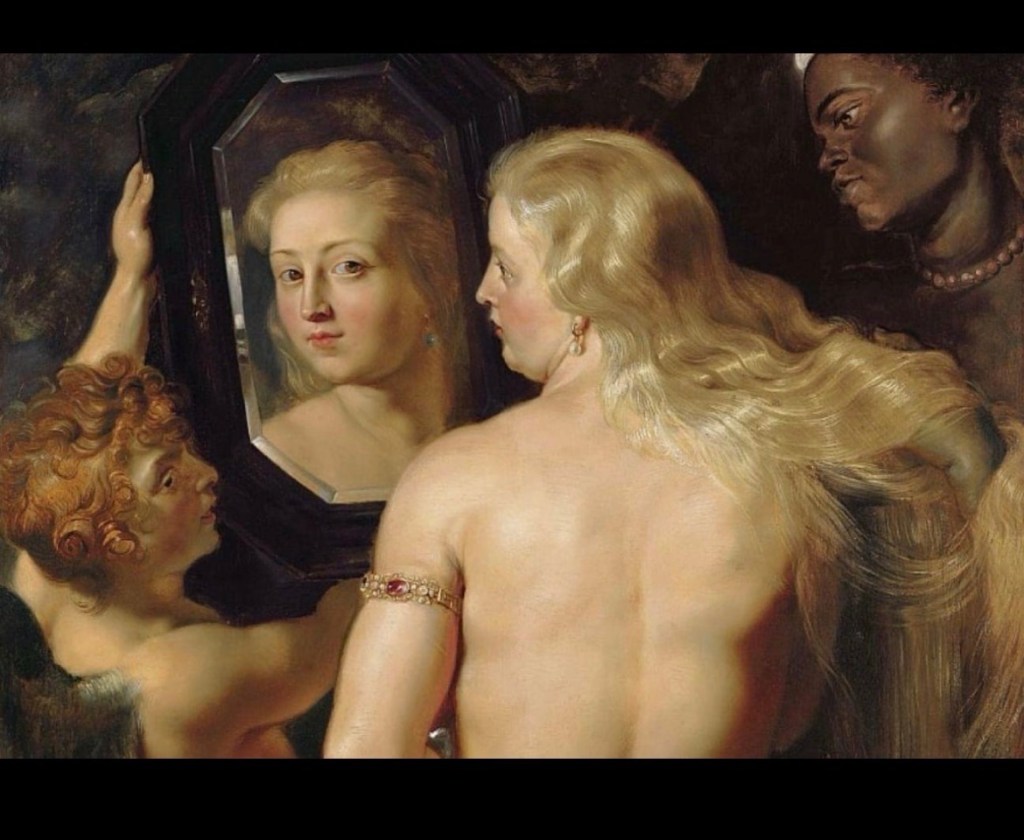
Venus at a Mirror (c. 1614–1615)
His women have bodies.
Not the carefully edited, filtered, airbrushed bodies we’ve grown accustomed to seeing in magazines and on social media. I’m talking about actual flesh. Bellies that protrude. Hips that spread. Thighs that touch. Breasts that obey the laws of gravity.
And guess what?
They’re beautiful.
Rubens didn’t paint every woman as though she had been surviving on lettuce leaves and self-denial. His figures often appear soft, sensual, abundant, and unapologetically human.
Their flesh folds. Their skin creases. Their bodies occupy space.
And there is something wonderfully refreshing about that.
Consider one of his most celebrated paintings, The Three Graces, created around 1630–1635.
Three nude women stand together, their arms intertwined, surrounded by flowers and an idyllic landscape. Their bodies are rounded and fleshy, with soft stomachs, generous thighs, and natural curves.
They aren’t hiding themselves.
They aren’t sucking in their stomachs.
They’re simply existing in all their feminine glory.
Beauty Standards Have Always Been a Moving Target
Here’s something I find fascinating about human history.
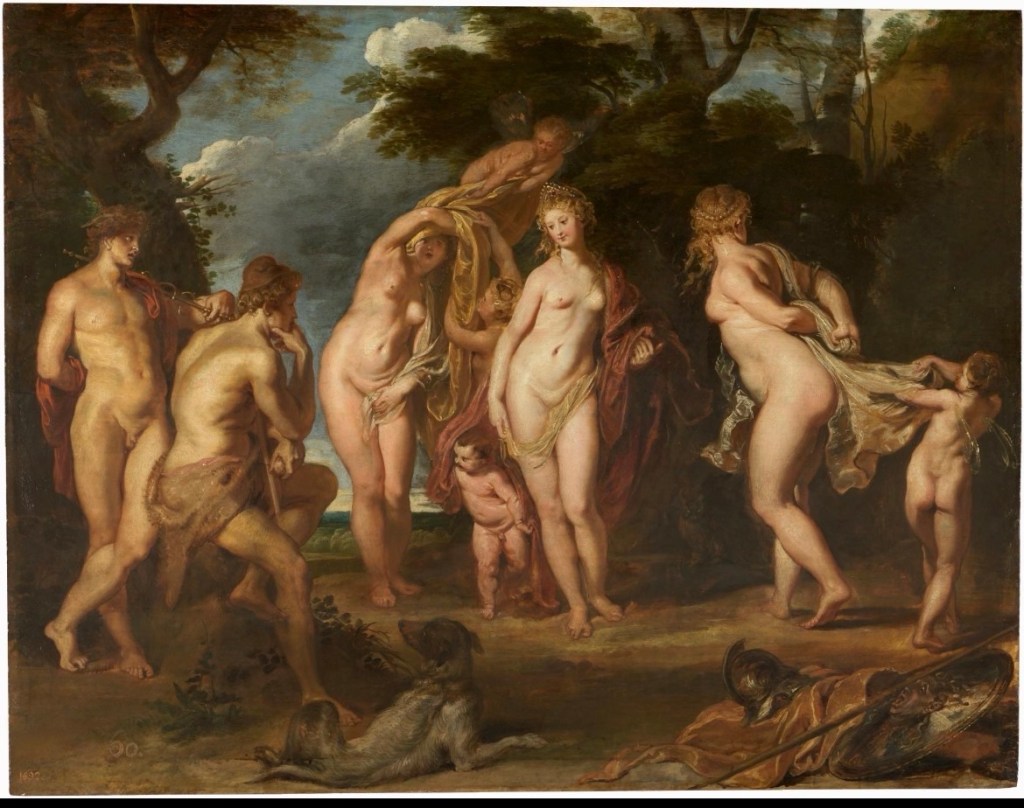
The Judgment of Paris (c. 1638–1639)
Beauty standards are not permanent truths. They’re cultural inventions.
What one generation considers desirable, another generation rejects.
During Rubens’s lifetime in the seventeenth century, fuller female figures could represent sensuality, fertility, abundance, and prosperity in European art. His paintings reflected certain ideals of his time, although slender women were also celebrated.
Fast-forward several centuries, and Western society began embracing increasingly slender female silhouettes in fashion and popular culture.
Then came the voluptuous Hollywood stars of the 1950s.
The extremely thin models of the 1960s.
The fitness obsession of the 1980s.
The waif-like supermodels of the 1990s.
And now we live in an era where women are simultaneously encouraged to have tiny waists, flat stomachs, large breasts, and enormous behinds.
Apparently, we’re supposed to be built like an hourglass manufactured in somebody’s laboratory.
And heaven forbid a woman should have a little belly to accompany that big behind.
The contradictions are exhausting.
What fascinates me about Rubens is that his paintings remind us that the female body has never had one universally accepted definition of beauty.
And perhaps it never should.
The Male Gaze and the Woman on the Canvas
Now, before we get too carried away romanticizing Rubens, there’s another conversation worth having.
He was a man painting women in a patriarchal society.
Many of his mythological paintings were created for wealthy patrons, often men, and female nudity was frequently presented for their visual pleasure.
That history matters.
Admiring Rubens’s paintings doesn’t mean pretending that seventeenth-century women enjoyed bodily autonomy or freedom from male expectations.
They most certainly did not.
And it doesn’t mean that fuller women were universally respected or treated better simply because some artists admired their figures.
But I find something intriguing about the contradiction.
Women whose bodies might be ridiculed by contemporary beauty standards have been immortalized in some of the world’s greatest museums.
People travel thousands of miles to stand before paintings of women with thick thighs, rounded bellies, and ample hips.
They call them masterpieces.
Yet a woman walking down the street with a similar figure may be told she needs to lose weight.
Isn’t that some shit?
We can appreciate the fullness of a woman’s body when it’s hanging in a gilded frame, but sometimes struggle to extend that same appreciation to the living woman standing in front of us.
A Woman Is Not a Before Picture
I think one of the most damaging things modern beauty culture has done is convince women that their bodies are perpetual renovation projects.
There’s always something to correct.
Something to shrink.
Something to lift.
Something to tighten.
Something to remove.
And the older a woman becomes, the longer that damn list gets.
But what if we stopped treating women’s bodies as unfinished work?
What if we understood that a woman’s beauty doesn’t disappear because her waist thickens, her breasts soften, or her stomach develops a little roundness?
Aging is not a moral failure.
Neither is being fat.
And thinness is not a certificate of virtue.
Women deserve dignity and respect regardless of their size, age, or appearance.
I think about the women Rubens painted and how their bodies have survived centuries of changing tastes.
Empires have fallen.
Kings and queens have died.
Fashion has changed a thousand times.
And there those women remain, in all their soft, fleshy glory, reminding us that beauty is far more expansive than whatever happens to be fashionable.
The Art of Taking Up Space
Perhaps what I love most about the Rubenesque woman is what she symbolizes to me.
Abundance.
Sensuality.
Softness.
Presence.
She doesn’t have to make herself smaller to be worthy of admiration.
And that’s something women, particularly older women, could stand to remember.
We’ve spent so much of our lives being told to shrink.
Shrink our bodies.
Shrink our ambitions.
Shrink our voices.
Shrink our expectations.
Don’t be too loud. Don’t be too opinionated. Don’t be too demanding. Don’t take up too much room.
And for God’s sake, don’t get old.
Well, to hell with all of that.
There is something powerful about a woman who decides she has no intention of apologizing for the space she occupies.
Whether she’s a size 2 or a size 22, her body belongs to her.
Not to the fashion industry.
Not to social media.
Not to some man who believes women’s bodies exist exclusively for his viewing pleasure.
And certainly not to the bathroom scale.
A Masterpiece in Her Own Right
I don’t know what Peter Paul Rubens would think about modern beauty culture.
Perhaps he would be fascinated by cosmetic surgery, Photoshop, and the enormous industry built around convincing women that their natural bodies are inadequate.
Or perhaps he would simply pick up his paintbrush and get to work.
But I do know this.
His paintings offer a useful reminder that the standards we treat as absolute today may look ridiculous to people centuries from now.
The female body has been worshipped, regulated, idealized, criticized, concealed, and displayed throughout history.
And somehow, women are still being told that they aren’t quite good enough.
Maybe it’s time we stopped allowing every generation to redefine our worth according to the fashionable dimensions of our bodies.
Because the truth is, a woman doesn’t need the approval of a seventeenth-century painter or a twenty-first-century beauty influencer to be beautiful.
She doesn’t need to resemble a Greek goddess, a Renaissance muse, or a supermodel.
She can simply be herself.
Soft belly. Thick thighs. Stretch marks. Laugh lines. Sagging breasts. Gray hair. Or none of the above.
A body that has lived, loved, aged, endured, and carried her through this world.
And that, my darlings, is a masterpiece no museum could ever contain.
The Potty Mouth Granny
Where wisdom, womanhood, and a little profanity meet.


Leave a Reply